

Quiet rear
Authors

Over the past four years of the Russian-Ukrainian war, the Lukashenko regime has become a key ally and a reliable supporter of Putin’s army. Belarusian enterprises are working hard to meet the needs of the Kremlin’s war machine. Buro reveals details of the bloody collaboration that has claimed civilian lives.

DEADLY WEAPON
“He was at his work station when the bombs hit. The temperature was so high that there were no bones left. This kind, cheerful, and sincere man turned to ash in an instant”, says Hanna Kharlamova, a Ukrainian, describing the death of her ex-husband.

A Russian missile hit a construction hypermarket in Kharkiv. Source: suspilne.media
Anton Polyakov’s life was cut short in the Russian attack on Kharkiv on May 25, 2024. At around 4 p.m., Su-34 frontline fighter jets dropped bombs on the Epitsentr construction hypermarket, where the 42-year-old resident of Kharkiv worked. The bombing killed 19 people, two of whom were children. More than fifty people were injured.
Russian fighter jets attacked the Kharkiv hypermarket with glide bombs. The production of this ammunition involves dozens of companies. Buro discovered a Belarusian connection to this whole story. The Minsk-based plants Peleng and OKB TSP supplied components to two military enterprises involved in producing the bombs that were dropped on Kharkiv.
We obtained access to the customs data of 10 enterprises in Belarus’s military-industrial complex. These data show that Belarusian companies have been supplying various equipment and components to Russian military plants since the beginning of the full-scale invasion. Export volumes exceed $150 million, mainly due to supplies from Peleng and OKB TSP.
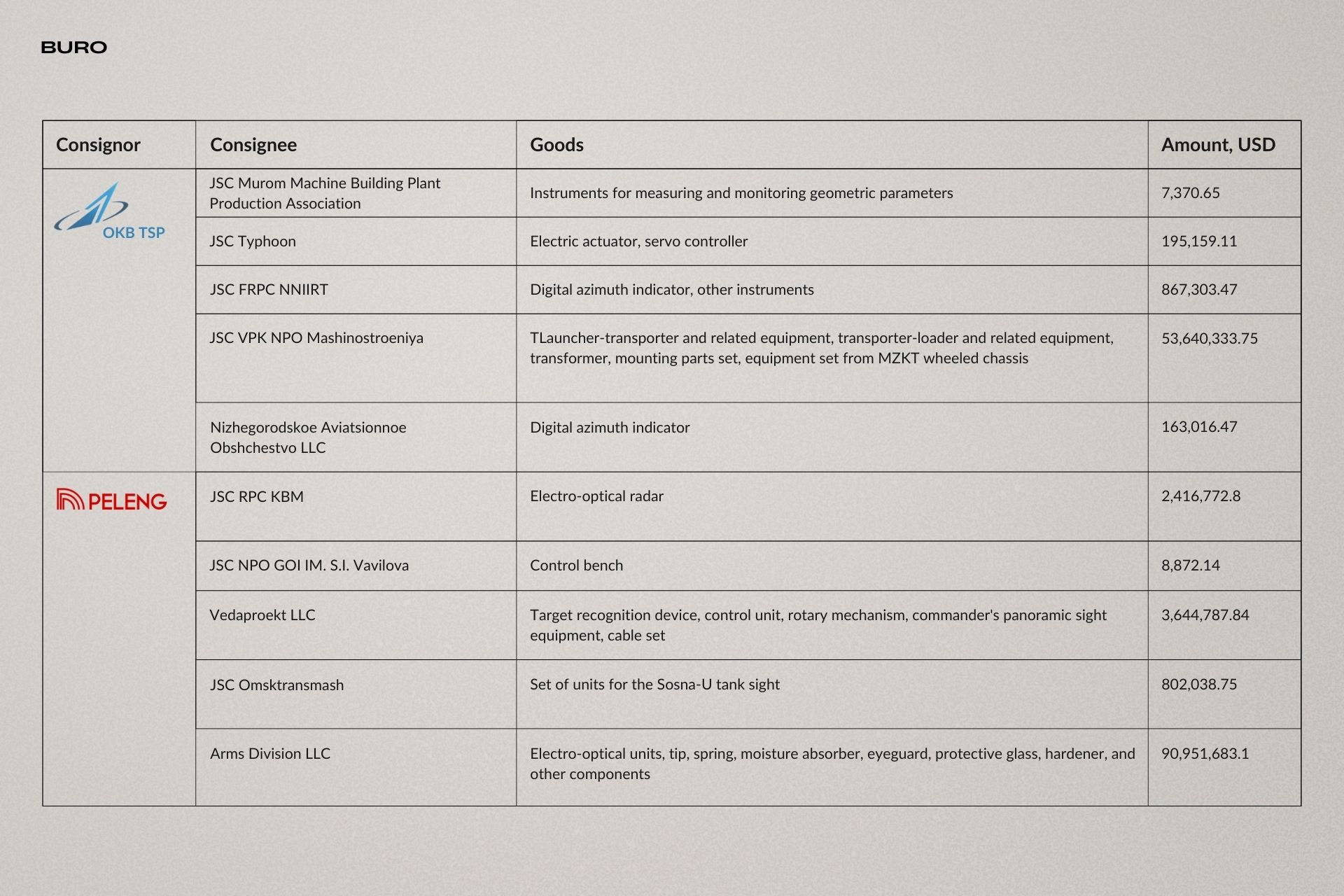
The Defence Intelligence of Ukraine provided us with a list of 19 Belarusian organisations that work for the Russian army.


These include enterprises of the military-industrial complex, such as the Volatavto, 2566th Radio-Electronic Weapons Repair Plant and the Minsk Wheel Tractor Plant (MZKT), as well as ordinary plants such as the Brest Electric Bulb Plant, the Maladzechna Powder Metallurgy Plant, and the Minsk Automobile Plant (MAZ), among others.
“Because Belarusian enterprises are involved in circumventing sanctions and can produce highly specialised equipment, Russia can increase production of certain types of weapons used in combat operations”, said Pavlo Rad from the Ukrainian Prism think tank in a commentary for Buro.
The obtained customs data showed that, between 2022 and 2025, the OKB TSP plant supplied electric actuators and servo controllers to Typhoon, a Kaluga-based instrument-making plant. Meanwhile, Peleng supplied Vedaproekt, a Moscow-based company, with control units, rotary devices, cable sets, commander’s panoramic sight equipment, and target recognition devices. Ukrainian intelligence reports that these Russian enterprises are involved in the production of UMPB D-30SN aerial bombs. Vedaproekt is responsible for supplying the terminal guidance systems, while Typhoon manufactures the warhead body tubes.
“In theory, Belarusian enterprises could be involved in acquiring sanctioned components, or even manufacturing their own parts, for UMPB D-30SN aerial bombs”, believes Pavlo Rad.
OKB TSP does not hide its cooperation with Russian defence enterprises, but claims to have no information on how its products are ultimately used.
“They [Kaluga’s Typhoon instrument-making plant] have ordered our production bundle, but how they will use them further, I have no idea. I don’t know what they do with it; I don’t have access to their products. We are in no way involved in this campaign [the war against Ukraine]. Neither directly nor indirectly. We do not trade in any weapons”, Siarhei Vinahradau, head of OKB TSP, told Buro.
Meanwhile, the EU and the US have imposed sanctions on the Belarusian company for its links to the Russian defence industry.
Peleng CEO Pavel Pazdniakou declined to comment. Peleng is also subject to Western sanctions for supplying components for Russian military equipment that has been used in the war against Ukraine.
SAFE HAVEN
The Belarus-Russia partnership extends beyond supplying parts to manufacturers of aerial bombs. We found other examples in the customs data.
Peleng is a major Belarusian manufacturer of optics and electronics in which the state holds a stake. The company sold optoelectronic units to the Moscow-based Arms Division LLC and electro-optical radars to the Kolomna-based RPC KBM JSC (Machine Building Design Bureau). The latter developed the Tochka-U, Iskander-E, Verba, Igla, Shturm-S, and Khrizantema-S missile systems. According to Ukrainian intelligence, Peleng’s facilities manufacture fire control systems for T-90M tanks and sights for T-72BA, T-90S, T-90M, T-90MS, and BTR-82A tanks. They also produce sensors for Pantsir-S1 and Pantsir-S1M anti-aircraft missile systems.
OKB TSP is a private Belarusian military enterprise with links to Siarhei Batsenouski, the son-in-law of the former Belarusian Prime Minister, Siarhei Ling. The company delivered transportation modules for missile systems to the Moscow region. VPK NPO Mashinostroeniya (the Scientific and Production Association of Machine Building), which developed combat cruise missiles, strategic missile systems, and small spacecraft, is listed as the consignee in customs declarations.

In May 2020, Aleksandr Lukashenko visited the OKB TSP’s experimental test site, where he signed off on the first Belarusian anti-aircraft guided missile. Source: president.gov.by
“The West... (and) Ukrainians reproach us: ‘You are helping Russia’. Why shouldn’t we? We [Lukashenko and Russian TV presenter Olga Skabeyeva] visited the enterprise where ammunition is manufactured, and she saw the ammunition and missiles that we supply to Russia… We’re not hiding anything. There is a war in which our ally is fighting”, admitted Aleksandr Lukashenko.
From the very first day of the war, the Belarusian authorities did everything in their power to help the Russian army: they provided military and medical infrastructure, allowed Russian aircraft to use their airspace, trained conscripts, transferred ammunition and equipment from their warehouses, and posed a hypothetical threat on the border with Ukraine.
“This stage was marked by the near-total involvement of Lukashenko’s regime in supporting the Russian army, driven by the use of Belarusian territory for the offensive against Ukraine’s northern regions, as well as the presence of a large contingent of Russian troops in Belarus”, emphasized Pavlo Rad of the Ukrainian Prism think tank.
According to him, the role of Lukashenko’s regime has been somewhat transformed since spring 2023, when Russia was finalising the withdrawal of troops from Belarus. In addition to creating a hypothetical threat on the Ukrainian border, the regime is also carrying out information and psychological operations. The Belarusian military-industrial complex is working hard to meet the needs of Putin’s army.
“Currently, Lukashenko is important not so much as a combatant, but as a provider of a safe haven where military products can be manufactured without the risk of attack. After all, Ukraine strikes Russian defence enterprises, but refrains from attacking Belarusian territory”, says Pavlo Rad.
The expert identified three key areas of focus for the Belarusian military-industrial complex.
The first focus area relates to the production of special-purpose wheeled equipment. The Topol-M, Iskander, and S-400 Triumf missile systems, for example, are installed on wheeled chassis produced by the Belarus-based MZKT enterprise. According to Ukrainian intelligence, the Minsk Automobile Plant is supplying the Russian military with trucks.

The MZKT chassis that can carry the Iskander missile system. Source: volatdefence.com
The second focus area, identified by the Ukrainian expert, concerns the repair and modernisation of equipment. The 558th Aviation Repair Plant specialises in the repair and modernisation of Russian aircraft, including the Su-25, Su-27, Su-30, and MiG-29, as well as the Mi-8 and Mi-24 helicopters. According to Ukrainian intelligence, employees at the 2566th Radio-Electronic Weapons Repair Plant in Barysau are involved in repairing 9M33 anti-aircraft guided missiles. Meanwhile, Zavod SVT in Minsk repairs and maintains electronic equipment for missile systems.
The third focus area encompasses the production of optical devices, sighting systems, fire control systems, and weapons control systems, as well as radio-electronic equipment and software systems. For instance, the Optik plant in Lida supplied Russia with optical components for the sighting and observation systems of the BTR-82 armoured personnel carrier. Minsk-based Integral is one of the leading manufacturers of microchips for a variety of missiles. According to Ukrainian intelligence, the company exported more than 6 million microchips to Russia worth $130 million between March 2022 and June 2024.

February 2025. Aleksandr Lukashenko on a visit to Integral. Source: president.gov.by
Belarusian-made electronics were found in the Kh-69 cruise missiles. Russia used them to attack Ukraine’s critical infrastructure. According to Ukrainska Pravda, such missiles destroyed the Trypilska Thermal Power Plant in April 2024. It was the largest electricity supplier in the Kyiv, Cherkasy, and Zhytomyr regions.
“The scale of the destruction is horrific. You can’t put a price on that. This is the biggest challenge we have ever faced as a company”, said Andrei Hota, Tsentrenergo’s top manager.
A GOLDEN GOOSE
Before the war, around 100 Belarusian enterprises supplied nearly 2,000 items of production to 255 Russian defence enterprises. Now that number could be much higher. Ukrainian President Volodymyr Zelensky spoke of three thousand Belarusian enterprises that have been “put at the service of the Russian war”.
“Our cooperation is bilateral in nature and based on the mutual exchange of technology. Nowadays, the Russian Federation cannot fulfil its state defence order without Belarusian components, just as we cannot fulfil ours without Russian ones. The range of components, parts, and assemblies used by both countries is so broad that we can speak of the full integration of production chains”, said Dzmitry Pantus, head of the State Military-Industrial Committee of Belarus (SMIC).
Buro journalists called him, but he declined to discuss the use of Belarusian equipment and components in the war against Ukraine. We have sent a request to SMIC and haven’t received any response.
Belarus has become Russia’s key ally in arms production due to logistical convenience, the use of similar types of equipment, and Belarusian arms makers’ unique expertise in areas where Russia lacks the necessary technology.
“Minsk saw opportunities for substantial earnings from supplying its products to Russia, and decided to capitalise on them”, believes Pavlo Rad.
According to the BelPol initiative, exports from Belarusian military-industrial complex companies rose from nearly $500 million in 2022 to $1.2 billion in 2024.
“Domestic needs do not drive the boom in military production in Belarus, the war in Ukraine does”, said BelPol in its report.
The Foreign Intelligence Service of Ukraine has reported that Belarus is planning to further increase its defence production to meet the needs of the Russian military-industrial complex.
“The Belarusian government is speeding up the construction of facilities related to drones, electronics with dual-use applications, and targeting equipment. Projects with military potential have become a priority in the country’s innovation strategy, which previously focused on civilian industries”, noted the intelligence agency.
For example, Ukrainian intelligence sources claim that Belarus is planning to fine-tune the entire production cycle for 122 mm rocket missiles and 152 mm artillery shells.

July 2024. Vladimir Putin and Aleksandr Lukashenko meet on Valaam Island. Source: kremlin.ru
Belarus and Russia have already established a programme for military and technical cooperation that will last until 2030. It envisages joint research and development of new weapons, modernisation of existing ones, and joint production of finished weapons, military equipment, and their components. It also involves implementing joint policy measures in pricing, standardisation, and the cataloguing of military products.
“In the context of the war, Russian demand has become a ‘golden goose’ for the Belarusian military-industrial complex because Belarusian manufacturers can supply a large number of products to Russia and sell them at significantly inflated prices”, Pavlo Rad emphasised.
Ukraine believes that Lukashenko and his regime should be held accountable for their complicity in Russian aggression.
“All the legal grounds are there for this”, said Ukrainian Foreign Minister Andrii Sybiha in a comment to Ukrainska Pravda.