

Sharp turn
Authors

A fatal accident occurred earlier this year in a suburb of Stockholm. A truck collided with a car belonging to a driving school. The student was injured, and the traffic officer administering the driving test did not survive. The deadly accident in Sweden unexpectedly led investigators to Belarus.
The truck’s trailer featured the Jenty logo and a link to the website jenty-spedition.com. This is the logo and website of Jenty-Spedition, a major transport company with an office in the suburbs of Minsk.

A traffic accident in the suburbs of Stockholm. Source: Blåljusbilder
But how did the truck end up in Sweden when Belarusian carriers are banned from operating in the EU due to sanctions? We teamed up with our colleagues from SVT and Fundacja Reporterów to dig into who was behind that shipment operation and how it was connected to Belarus.
POLISH SUBCONTRACTOR
We discovered that the cargo transport was organised by the Polish company DSPL on that tragic day. DSPL is owned by Georgian citizen Nikoloz Geguchadze. He confirmed to Buro that the company’s truck had been involved in the accident, offering his condolences for the loss of life. The businessman emphasised that the case had been officially investigated by the relevant Swedish authorities, that the driver had been cleared of suspicion and that the case had been closed.
Geguchadze claimed he didn’t see anything unusual about the use of the Jenty logo, which belongs to a Belarusian company, on the truck trailer. He said that DSPL works with many partners, which is why their trucks and trailers may bear their logos. However, the businessman did not explain exactly what the collaboration between DSPL and Jenty entails.
“The presence of any such markings [logos] <…> does not, in and of itself, establish ownership, control, liability, or any specific legal or corporate relationship between the companies”, Geguchadze noted.
Our colleagues at SVT in Sweden have revealed further information about the connections between the Polish and Belarusian companies. In fact, the truck was carrying medical supplies manufactured by the major pharmaceutical company AstraZeneca. The supplies were being transported from a plant near Stockholm. AstraZeneca has confirmed that it is using a British firm to transport the goods, which is subcontracting some of the services to Technobel in Kazakhstan and DSPL in Poland. The plan, as revealed in correspondence with the Swedish authorities, was to deliver the medicines to Russia.
“Concerning this transport operation [which resulted in a fatality], the driver is employed by DSPL in Poland and holds a valid Polish work permit. The truck itself is registered in Poland, while the trailer is registered in Kazakhstan. All of this is fully compliant with applicable laws and regulations and does not violate any sanctions”, AstraZeneca told SVT. According to information from AstraZeneca, DSPL is a subcontractor of Jenty.
Therefore, we had a hunch that the Belarusian company Jenty might have reorganised its business in response to sanctions. While the European Union does not prohibit the export of medical supplies to Belarus and Russia, Belarusian and Russian transport companies cannot transport them within the European Union without permission from the relevant authorities. The sanctions were imposed in April 2022, after Russia invaded Ukraine with the assistance of the Belarusian regime. Two years later, the restrictive measures were tightened to prohibit European companies with more than a 25% ownership stake by Russian or Belarusian entities from operating in the EU.
It seems that Jenty Holding Company was prepared for this turn of events. We uncovered close ties between transport companies operating in different countries.
PRECAUTIONARY MEASURES
When DSPL was founded in Warsaw nearly five years ago, its CEO moved there directly from the Belarusian company Jenty. The founder was a Russian woman who is also affiliated with Jenty. The Warsaw-based firm received its start-up capital from abroad. Technobel provided a loan of €8 million. This entity is owned by businessmen from Jenty. These same individuals used to own DSPL for quite some time.
Vasily Smetanin is the key figure in this transportation holding company. He holds both Russian and Belarusian citizenship. In addition to providing transportation services in the CIS countries and Europe, he is involved in coal mining, agriculture, and construction in Russia.

Vasily Smetanin. Source: fund.mipt.ru
Until early March 2024, Smetanin was the beneficiary of the Polish company DSPL. Control of the transport company then passed to another businessman. This turned out to be Smetanin’s long-standing partner from Georgia, Nikoloz Geguchadze. Together, they are developing a resort complex in Adjara on the Black Sea coast.
Similar changes have also taken place at other Polish companies. In addition to DSPL, Smetanin held a stake in the transport companies Azonik, Birc Transport and Starprim. In 2024, Smetanin’s partner, Geguchadze, took over as the majority owner of all these companies.
The Georgian businessman insisted to Buro that the takeover of the Polish companies was conducted on standard commercial terms and was not intended to bypass sanctions.
However, some of our findings suggest otherwise. For example, an employee of the Warsaw-based company DSPL told colleagues from SVT that it is part of the Belarusian company Jenty.
Birc Transport, a company based in Białystok whose principal owner is currently Geguchadze, is part of the Kapitan group of companies. This group also includes the Belarusian firm Viptrans-Spedition and the Russian firms Rusant and Lidergruzavto, whose main beneficiaries are the Smetanin family.
In 2025, a lawyer who had worked with Jenty-Spedition for a long time represented Geguchadze’s interests in Birc Transport. Two years earlier, she had represented the interests of Eastin Forwarding Holding, an Austrian company owned by Smetanin, at Birc Transport.
The Russian and Georgian businessmen are still partners in the transport company Rezon Trans, which is based in Lublin. Interestingly, Smetanin’s Austrian firm has reduced its stake from 70% to less than 25% in accordance with European sanctions law.
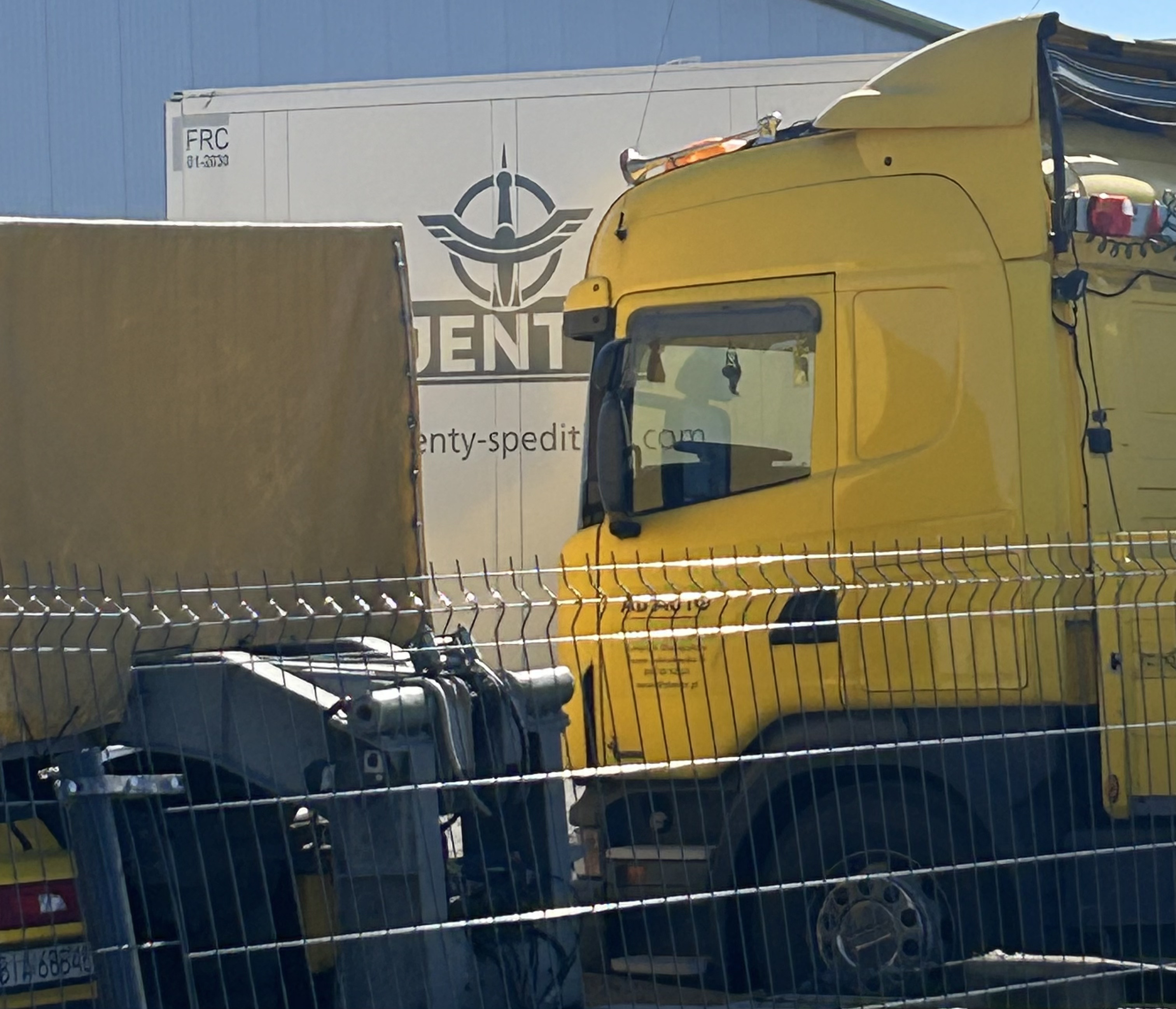
truck bearing the Jenty logo at the transport depot of the Polish company Azonik. Source: Fundacja Reporterów
According to experts, the change in ownership of Polish companies is intended to provide “legal and reputational security” amid EU sanctions.
“My guess is that he [Smetanin] transferred his shares as a precautionary measure to safeguard his company and financial interests [in light of the sanctions]”, Alex Prezanti, a lawyer at the State Capture Accountability Project, told Buro.
Neither Jenty-Spedition, Technobel nor Smetanin have responded to our calls or enquiries.
QUICK RESPONCE
AstraZeneca responded swiftly to the findings of our investigation. The pharmaceutical company stated that it had not breached any laws, regulations or sanctions, but nevertheless takes the information set out in our report very seriously. Subcontracted transport companies will no longer be used to transport goods.
“We have instructed our logistics provider that the subcontractors mentioned in the investigation may no longer be used for AstraZeneca’s transport operations within the EU. The provider has confirmed that this is now being implemented as quickly as possible, without jeopardising the delivery of life-saving medicines to patients”, the pharmaceutical company reassured SVT.
Vladyslav Vlasiuk, the Presidential Commissioner for Sanctions Policy of Ukraine, also responded to our joint investigation. He believes that circumvention of sanctions should be investigated.
“The people of Ukraine are bearing tremendous sacrifices. Seeing these victims alongside such schemes to circumvent sanctions is disappointing”, said Vlasiuk in a conversation with SVT journalists.
According to him, even if the case concerns pharmaceutical products that are not prohibited from being exported to Russia, the issue lies in the logistics involved. Vlasiuk observed that the same routes and supply chains could be exploited to circumvent sanctions when delivering microelectronics intended for Russian missiles and drones.
“Some of this information must, of course, be officially verified. We will send a request to the Swedish government proposing that they consider launching an official investigation. After all, we take the circumvention of sanctions very seriously. As far as I know, the Swedish government also takes it [the circumvention of sanctions] very seriously. And, naturally, we’d like to see some real action”, Vlasiuk stated.
The Polish Ministry of Infrastructure has told Fundacja Reporterów that Poland’s General Inspectorate of Road Transport has inspected more than 11,000 companies for sanctions violations over the past two years. The ministry has also scrutinised over 650 companies in which Belarusians and Russians hold a stake of over 25%. Proceedings have been initiated against 453 organisations to revoke their transport licences. Most of the cases have already been resolved.